
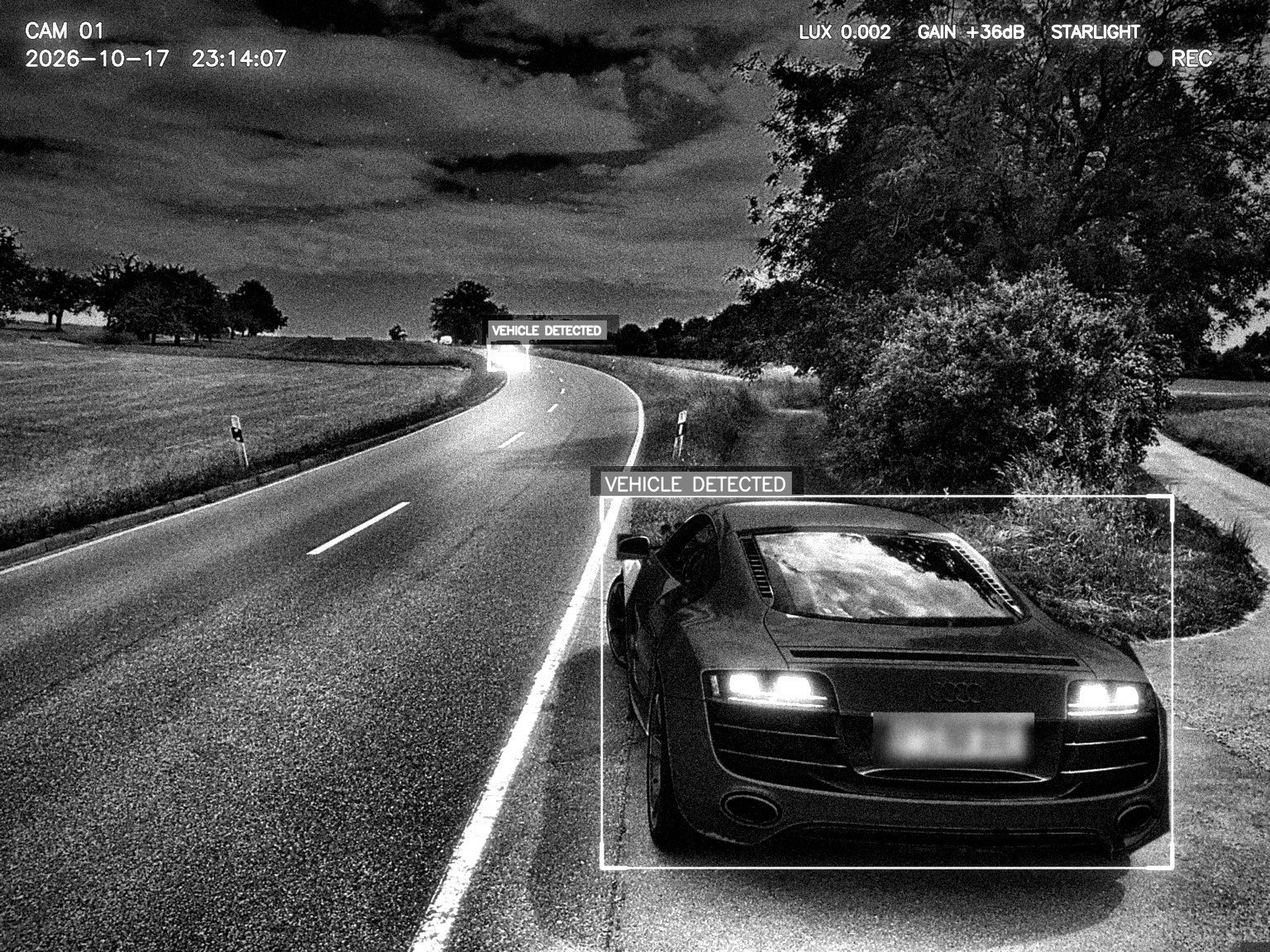
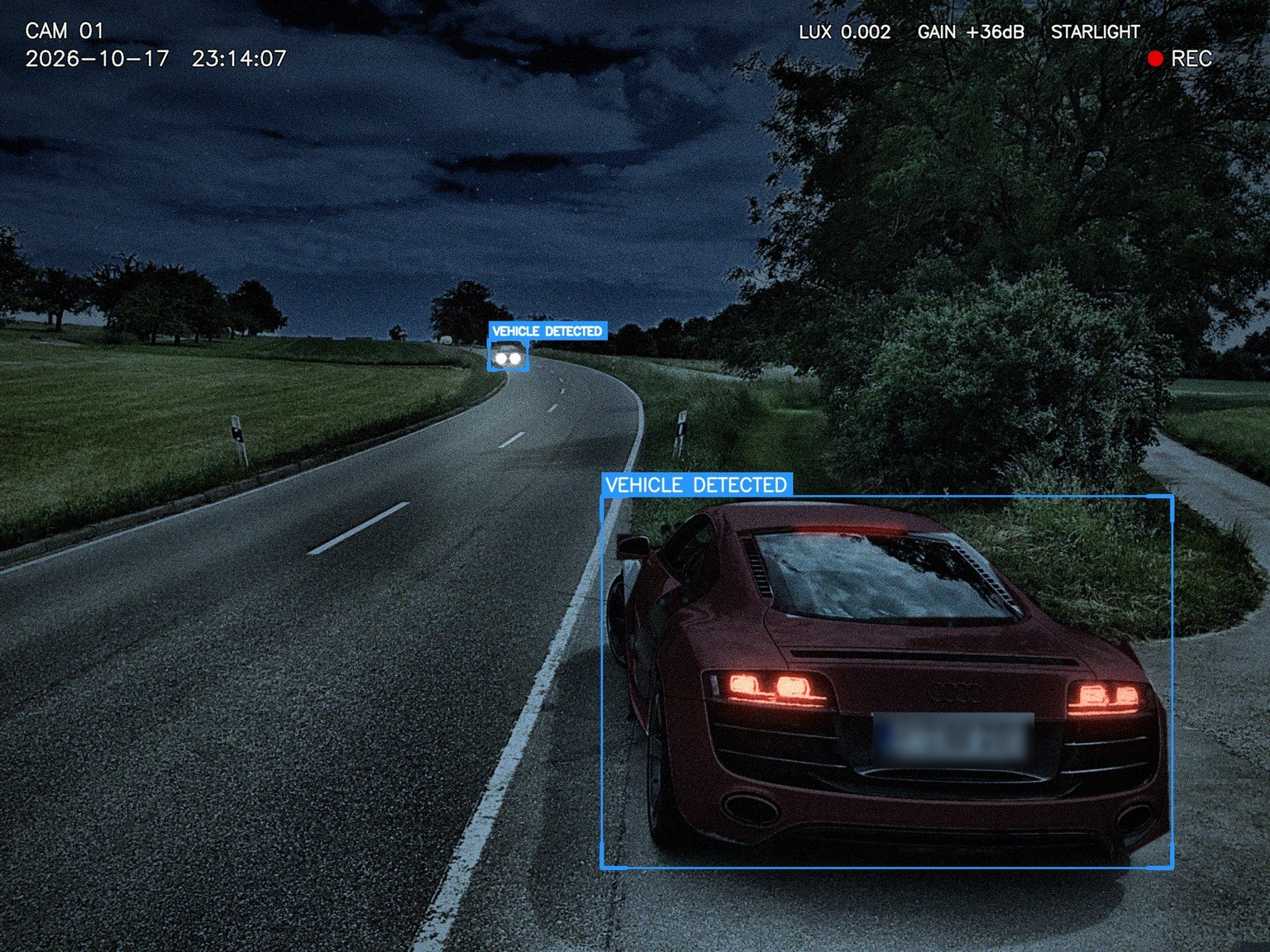
Most surveillance footage shot at night looks the same: grainy, monochrome, lit by a ring of infrared LEDs that the human eye can't see but the sensor can. It works for detecting that something moved. It is far less useful for working out what that something actually was.
What infrared night vision actually gives up
A conventional camera switches to an infrared-sensitive mode after dark because ordinary image sensors don't gather enough visible light in low-light conditions to form a usable picture. The infrared LEDs illuminate the scene in a wavelength outside human vision, and the sensor captures that reflected light as a greyscale image. It's a reasonable compromise — until identification matters.
Colour is one of the fastest things a person uses to identify a vehicle, a piece of clothing, or a specific object in a scene. Strip it out, and a white sedan, a silver sedan and a light grey sedan can become indistinguishable in a still frame. For an investigation, an insurance claim, or a security team trying to match a description radioed in from the field, that loss of detail is the difference between useful footage and footage that simply confirms something happened.
How colour night vision works without infrared lighting
Our engineering team's approach keeps the sensor operating in its native colour mode after dark, and does the work of extracting a clean, true-colour image through sensor and lens selection, noise reduction tuned specifically for low light, and signal processing that controls for the very low photon counts involved — without relying on an infrared illuminator to compensate. The result is a frame that still looks like colour video, not a colourised black-and-white image.
This isn't a software filter applied after the fact. It starts with choosing a sensor and lens combination capable of gathering enough usable light, and continues through every stage of our image-signal-processing pipeline — the same pipeline responsible for handling wide dynamic range against headlight glare, and motion-blur control in fast-moving scenes.
Why this matters for Indian deployment conditions
Street lighting in Indian cities and highways is inconsistent — some stretches are well lit, many are not, and headlight glare from oncoming traffic is a constant variable that most camera tuning, developed for other markets, doesn't account for well. Add monsoon rain, dust and haze, and a camera's low-light and night performance becomes one of the most deployment-critical specifications in the entire product, more so than headline resolution.
This is also why image quality sits at the centre of how our team is organised, rather than being treated as a downstream tuning step. We maintain an in-house image-quality lab — one of very few fully equipped facilities of its kind in India — specifically so that this kind of tuning work can be iterated on directly against real sensors and real lenses, rather than guessed at from a datasheet.
What this means if you're specifying a camera product
If low-light and night performance matters for your deployment — and for most security and surveillance use cases, it does — ask any vendor to show you actual night-time footage at the distances and lighting conditions you expect to deploy in, not a marketing still shot in ideal conditions. Resolution numbers on a spec sheet say very little about what a camera can actually resolve after dark.